Sunday, March 6, 2011

The Hindavi Sufi Romance


The cultural history of sultanate India is, in part, the history of the enthusiastic participation of Sufis and other Muslims in the formation of the canons of Indian poetry, art, and music. The genre of the Hindavi Sufi romance should be read against this larger background of cultural appropriations, co-minglings, and creative formulations. The Hindavi Sufi poets used Sanskrit rasa theory and the conventions of Persian poetry to create a mystical romantic genre centred around the various meanings of prema rasa, the juice or essence of love. While it is important to understand their poems as aesthetic and mystical creations, this genre can nevertheless be read for marks of historical process and seen as embodying a history of narrative motifs.
The Hindavi romantic ideal of desire and its transformation into Sufi love is set in a fantasy world of marvels and exotic locales, of supernatural helpers and agencies who aid the hero along his way. The poets of the Hindavi Sufi romances articulate their distinctive aesthetics of self transformation through the narrative, the unfolding of a story in a fantastic fictional universe. These narrative universes have four characteristic features. First, inspired by Persian verse narratives (mathnawis), they relate the story of a spiritual quest that proceeds through the deferment of desire and the enticement of the hero/reader further and further on the journey of self transformation. Second, the fictional universe is formulic and episodic, but the poet structures these formulic motifs using abstract characters or narrative options like the different kinds of love,or .. the relative values of asceticism and sensual pleasure. Third, they are not directly allegorical but suggestive of general Sufi values through the ordeals and experiences of the hero. Finally the narrative motifs that the poets use reveal a history of complex interactions between, on the one hand, Persian and Arabic storytelling, and on the other, Sanskrit, Prakrit, and other narrative traditions in the Islamic and pre-Islamic world of the Indian Ocean. - Aditya Behl in the Cultural History of Medieval India edited by Meenaskhi Khanna

Yoga Vasista


Along with the Bhagvada Geeta and Patanjali’s Yoga Sutras, the Yoga Vasista or Maharamayana is a key Indian yogic text which explains how fluctuations of the consciousness can be overcome and the highest self be realised. Yoga Vasista, traditionally attributed to Valmiki the composer of the Ramayana, employs interesting stories to achieve this end. The text is structured as a discourse between Prince Rama as a seeker and his preceptor Vasistha, the enlightened sage. It is believed that merely reading this book leads to self realization. As an Advaita Vedanta text, the Yoga Vasista deals with the knowledge of the all pervasive non dual consciousness and the unreality of the manifest world.

The story begins when the seer Vishwamitra arrives at King Dasaratha’s court to demand the company of Rama for the protection of his sacred rites from the flesheating rakshasas, only to hear that the later is absolutely dejected with the fickleness and meaninglessness of human existence. The court preceptor Vasista, who is also present, guesses that Rama is experiencing vairagya or detachment so essential for spiritual realisation. He offers to guide the prince through the process of enlightenment and does this through the medium of several fantastic stories. As the conversation proceeds, Rama attains enlightenment and discovers a completely new level of meaning and purpose to existence. Yoga Vasista is a vast text which presents varied cosmologies, creation theories, philosophies and tips for daily living as an enlightened being through some immensely enjoyable stories. - Swetha Prakash

Saturday, March 5, 2011

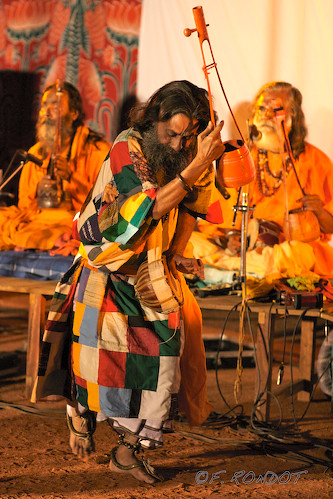
The Bauls of Bengal


'There is something very special and appealing about the Bauls, something significant and lasting. Once one's life has been touched by them, they can never be forgotten. Having heard their thrilling songs of passion and ecstasy and experienced their charismatic and spontaneous manner, there can be no turning away,' - Nik Douglas in the forward to the ‘The Path of the Mystic Lover: Baul Songs of Passion and Ecstasy.'

Friday, March 4, 2011

On Myth

'Myth can be defined in two ways. First, it is a sacred idea that is inherited over generations. Second, it is absurd, irrational, and fantastic concepts about the world that appeal to unsophisticated minds. The two meanings are two sides of the same coin.
Depending on one's point of view, a story, an image, or a custom can be sacred or stupid’

- Devdutt Pattanaik in Indian mythology: tales, symbols, and rituals from the heart of the subcontinent.

Friday, February 25, 2011

A Zen story


A student went to his meditation teacher and said, "My meditation is horrible! I feel so distracted, or my legs ache, or I'm constantly falling asleep. It's just horrible!"
"It will pass," the teacher said matter-of-factly.

A week later, the student came back to his teacher. "My meditation is wonderful! I feel so aware, so peaceful, so alive! It's just wonderful!'

"It will pass," the teacher replied matter-of-factly.

Source: http://www-usr.rider.edu/~suler/zenstory/willpass.html

Thursday, February 24, 2011

On the Mahabharata


"The Mahabharata is the creation and expression not of a single individual mind, but of the mind of a nation; it is the poem of itself written by a whole people. It would be vain to apply to it the canons of a poetical art applicable to an epic poem with a smaller and more restricted purpose, but still a great and quite conscious art has been expended both on its detail and its total structure. The whole poem has been built like a vast national temple unrolling slowly its immense and complex idea from chamber to chamber, crowded with significant groups and sculptures and inscriptions, the grouped figures carved in divine or semi-divine proportions, a humanity aggrandized and half uplifted to super-humanity and yet always true to the human motive and idea and feeling, the strain of the real constantly raised by the tones of the ideal, the life of this world amply portrayed but subjected to the conscious influence and presence of the powers of the worlds behind it, and the whole unified by the long embodied procession of a consistent idea worked out in the wide steps of the poetic story." - Sri Aurobindo

Monday, February 14, 2011

Swedish delegation at Kathalaya

The Swedish delegation comprising of Annelie Stark, President,
Lars Nordstrom, Vice President, Cultural affairs Committee, Region Vastra Gotaland, visited Kathalaya on 9th of February 2011. Ylva Gustafsson also came with them. Ola Henricssson, teacher and story teller at Bergsjon,Goteborg along with Geeta Ramanujam and Ambica did a workshop for two days. Three Swedish students of storytelling Maon Jasim, Sabina Krasniqi, Emma Murselovic were the part of the workshop. All the four story tellers along with P.Nagalakshmi and Usha Kolluru (Kathalaya resource people) enthralled the children of 1st and 2nd Standard of Shishugriha school in Tippasandra on 10th. On the same evening, a story space was organized were 25 people exchanged and enjoyed stories. Peter af Wetterstedt, Secretary of International affairs, Region Vastra Gotaland, also joined this Story Space. Academy students Sarita, Lakshmi, Sahana, Arathi, Varalakshmi and Bhuvana, Usha Venkatranman came with their family and friends.
0n the 12th, Ola Henricsson and Geeta Ramanujam did a workshop for adults at the British Council for about 40 people. On the same evening both of them enthralled about 40 children at Easy Library, Koramangala. Both of them told chain stories, which children and accompanying parents enjoyed. Vanishree Mahesh of Easy Library hosted the show.