Saturday, February 12, 2011

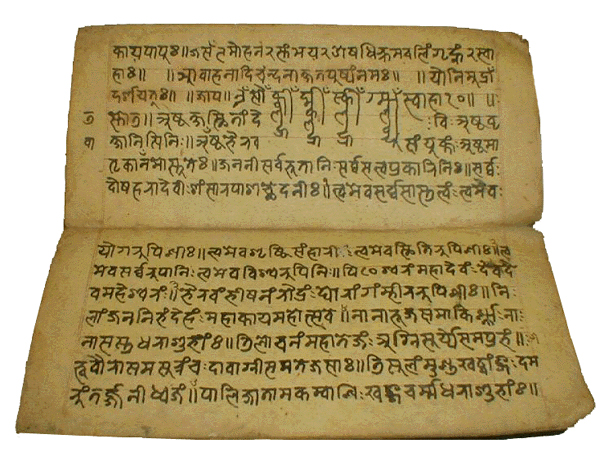
A vedic hymn


1. He is the first born, born of the golden womb – the Hiranyagarba. He is the lord of everything that was, is and will be. With his sole might the earth and heaven became stable. Unfathomable is this deity to whom all this belongs.
2. He is the lifebreath of the living, he is the might of the strong. His is the command which all the luminous gods revere; his stride is immortality, his shadow is death. Unfathomable is this deity to whom all this belongs.
3. Through his might alone he became the overlord of all these worlds, of all the men and beasts that live. Unfathomable is this deity to whom all this belongs.
4. He through his might wills these snowy mountains and this never ending sea into existence. Everything you see here are his two arms. Unfathomable is this deity to whom all this belongs.
5. He through whom the heaven and the earth were aligned, he through whom space came to be, and the firmament; he who measured the air in the sky. Unfathomable is this deity to whom all this belongs.
6. He to whom heaven and earth, standing firm by his will, look up, trembling in their mind; he over whom the risen sun shines forth. Unfathomable is this deity to whom all this belongs.

Wednesday, February 9, 2011


Sanskrit, which has been aptly described as "the perfectly constructed speech dedicated to literary and religious purposes," is the language of song. These ancient peoples went deeply into the matter: while they sang their praise songs they wanted to understand exactly how the voice produced song, and they studied the breath in a way which had never before been attempted, and certainly has never since been excelled. They thought of it as "the breath of life," not merely as a supply of oxygen to the tissues, but as a direct means of real inspiration and the key to that deeper life which all so much long for. - Lylie Pragnell in The Philosophy of Speech

Originally printed in The Philosopher,Volume V, 1928
http://www.the-philosopher.co.uk/speech28.htm

Sunday, February 6, 2011

'We have a bequest of stories, tales from the old storytellers, some of whose names we know, but some not. The storytellers go back and back, to a clearing in the forest where a great fire burns, and the old shamans dance and sing, for our heritage of stories began in fire, magic, the spirit world. And that is where it is held, today.
Ask any modern storyteller and they will say there is always a moment when they are touched with fire, with what we like to call inspiration, and this goes back and back to the beginning of our race, to the great winds that shaped us and our world.
The storyteller is deep inside every one of us. The story-maker is always with us. Let us suppose our world is ravaged by war, by the horrors that we all of us easily imagine. Let us suppose floods wash through our cities, the seas rise. But the storyteller will be there, for it is our imaginations which shape us, keep us, create us -for good and for ill. It is our stories that will recreate us, when we are torn, hurt, even destroyed. It is the storyteller, the dream-maker, the myth-maker, that is our phoenix, that represents us at our best, and at our most creative.' - Doris Lessing

Source - "Doris Lessing - Nobel Lecture". Nobelprize.org. 6 Feb 2011 http://nobelprize.org/nobel_prizes/literature/laureates/2007/lessing-lecture_en.html

Saturday, February 5, 2011


I have always been fascinated to imagine the uncertain circumstance in which our ancestors – still barely different from animals, the language that allowed them to communicate with one another just recently born – in caves, around fires, on nights seething with the menace of lightning bolts, thunder claps, and growling beasts, began to invent and tell stories. That was the crucial moment in our destiny, because in those circles of primitive beings held by the voice and fantasy of the storyteller, civilization began, the long passage that gradually would humanize us and lead us to invent the autonomous individual, then disengage him from the tribe, devise science, the arts, law, freedom, and to scrutinize the innermost recesses of nature, the human body, space, and travel to the stars. - Mario Vargas Llosa

Mario Vargas Llosa - Nobel Lecture". Nobelprize.org. 6 Feb 2011 http://nobelprize.org/nobel_prizes/literature/laureates/2010/vargas_llosa-lecture_en.html

Thursday, January 27, 2011

“the vast literature, the magnificent opulence, the majestic sciences, the great realized souls, the soul touching music, the awe inspiring gods….! It is already becoming clearer that a chapter which has a western beginning will have a to have an Indian ending if it is not to end in the self destruction of the human race. At this supremely dangerous moment in history the only way of salvation for mankind is the Indian way “ - Dr. Arnold Toynbee, British historian

Wednesday, January 26, 2011


Sri Bhagavan become transformed while relating incidents from his vast collection of stories and tales. On one occasion while describing Gautama's joy at Goddess Parvathi coming to his ashram, Sri Bhagvan could not go on, for tears filled his eyes and emotion choked his voice. Trying to hide his plight from others, he remarked, "I don't know how people who perform Harikathas explain such passages to audiences and manage to do it without breaking down. I suppose they must make thier hearts hard like stone before starting thier work."
- From Spiritual Stories as told by Ramana Maharshi

Sunday, January 23, 2011


In South India, the art of story telling is referred to as Kathakalakshepa, which is a Sanskrit term meaning, “Katha” - story, “kala” - time, and “kshepa” - throwing away. In total it means spending time listening to stories. Such performances are held in temples, weddings and other religious or social functions. This is a one-person theatre where the performer has to be versatile in the aspects of exposition, singing and histrionics, and be able to interestingly narrate humorous anecdotes as well. The storyteller is looked upon as a teacher who is a scholar in ancient texts in Sanskrit and other vernaculars. He interprets the religious and mythological texts of the past to the present and future generations.

In the various States of India there are three traditions of storytelling. The first is the Purana-Pravachana, which literally means, “expounding the Purana”. The Purana-Pravachana was narrated by the Pauranika, who was an expert in the exposition. Such expositions are solemn and serious.

The second tradition, Kathakalakshepa is unique because the story is carried through various songs and compositions in different Indian languages like Sanskrit, Tamil, Marathi, Telugu, Kannada and Hindi, which is a peculiarity in the Tamilnadu-style of story telling.

The third is a folk art, prevalent in Andhra Pradesh (a State in South India), called Burrakatha. Burra is a drum that is shaped like a human skull (Burra means skull). In this tradition, gypsies narrate stories beating this drum. As referred to earlier, in Tamilnadu the folk story tradition is called Villu-pattu, viz., the bow-song.

Krteyadhyayato vishnum
Tretayam yajoto maghaihi
Dvapare paricaryayam
Kalautatu Harikeertanatu

Source: http://www.carnatica.net/harikatha1.htm